What's the benefits of Profhilo vs Profhilo Structura
- Haus Of Ästhetik
- Dec 5, 2025
- 8 min read
Updated: Dec 10, 2025

What’s the difference, and which treatment is right for your skin?
Walk into any clinic offering advanced injectables and you will notice one name appearing again and again: Profhilo. Marketed as a breakthrough in skin remodelling, Profhilo became one of the most popular aesthetic treatments in the UK thanks to its ability to hydrate, remodel and improve laxity without changing facial shape. In late 2023, IBSA Derma launched the next evolution of this technology: Profhilo Structura. Both products share the same scientific foundation, but they work differently and are designed for different treatment goals.
This guide explains both treatments clearly, based on the official manufacturer information and published clinical data.
The science behind both products
Both Profhilo and Profhilo Structura are based on IBSA’s patented NAHYCO® Hybrid Technology, which thermally fuses high- and low-molecular-weight hyaluronic acid into stabilised hybrid complexes. This matters because it delivers hyaluronic acid into the skin with very high purity and without chemical cross-linking agents.
According to the Profhilo brochure, the process creates a unique material that is high in concentration (64mg/2ml), highly spreadable, and integrates into tissue without forming lumps or altering facial identity. The goal is to restore the extracellular matrix, supporting fibroblasts, keratinocytes and adipocytes at multiple levels of skin biology .
In simple terms:
Profhilo improves the environment your skin cells live in, rather than simply filling space.
The four key stages of creating Profhilo Structura
The process begins with equal parts of two hyaluronic acid weights: 45 mg of high molecular weight HA (H-HA) and 45 mg of low molecular weight HA (L-HA).
This blend is exposed to controlled heat using NAHYCO technology. The heat disrupts the hydrogen bonds holding the H-HA chains together, opening the molecular structure.
The temperature is then reduced. As the solution cools, new hydrogen bonds form, this time linking H-HA to L-HA. This produces a network of stable “hybrid cooperative complexes”.
The outcome is a distinct molecular form of hyaluronic acid with new structural properties: Profhilo Structura.

In simple terms, instead of behaving like a “plug of gel”, Structura behaves like a woven network that the fat cells can reorganise through, leading to regenerative rather than purely volumetric results.
Profhilo: bioremodeling and skin quality
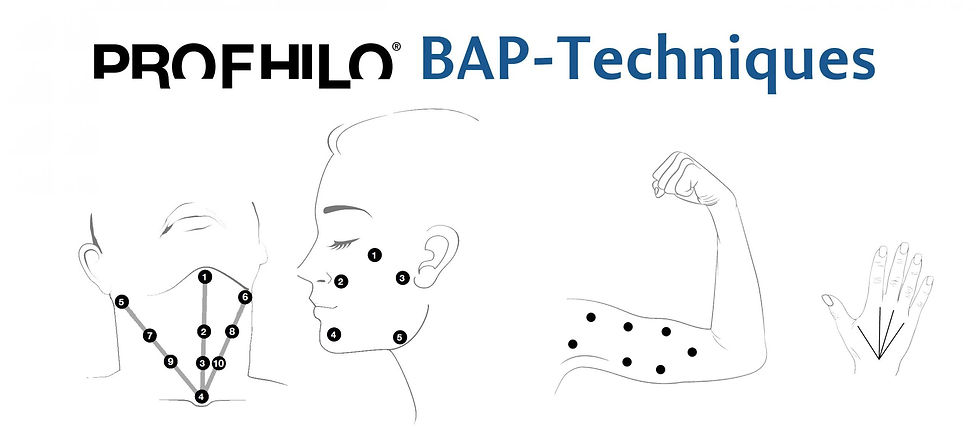
Profhilo is the original product, indicated for facial remodelling, hydration, and management of laxity. It is injected using the well-established BAP (Bio Aesthetic Points) technique, which places small volumes at five points on each side of the face. Because the product spreads through tissue, just 10 injections treat the entire mid-face.
Clinical studies show:
• improvement in hydration after one treatment
• improvement in elasticity after two treatments
• visible improvement in volume loss scales in 70 percent of treated patients
• high satisfaction rates from both patients and clinicians
Profhilo is ideal for:
• early to moderate laxity
• dull, dehydrated skin
• crepey texture
• fine lines from skin quality decline
• patients seeking an undetectable, natural result
Profhilo does not change facial structure. It does not lift in the sense that fillers lift. Instead, it creates healthier skin, which appears plumper, brighter and more elastic.

Profhilo Structura: volume support and tissue strength
Where Profhilo focuses on skin quality, Structura was developed for deeper support in patients where dimensional signs of ageing are more visible, such as volume descent, deflation of mid-face fat pads, or soft-tissue thinning.
The brochure describes Structura as a hybrid complex designed for deep tissue remodelling, providing mechanical support as well as cellular stimulation. While Profhilo spreads at the superficial subcutaneous layer, Structura is placed deeper, with the aim of strengthening structural layers that lose thickness with age.

In clinical language:
Profhilo = remodelling and hydration
Structura = remodelling and support
This is why many practitioners use Structura for:
• hollowed cheeks
• thinning temples
• structural weakness after weight loss
• mid-face support in peri-menopause and menopause
• ageing that is “dimensional” rather than textural
The two are complementary, not competitors. In the right patient, the best result uses both, Structura for support, Profhilo for skin quality.
Treatment experience and protocol
Profhilo involves two sessions, 30 days apart, with maintenance every 6–9 months. The treatment is quick, with minimal recovery, and suitable for most skin types.
Structura treatment protocols vary more, because it depends on the degree of volume loss and structural change.
At Haus of Ästhetik, treatment planning includes:
• medical history and medication review
• clinical photography
• skin elasticity assessment
• discussion of realistic outcomes
• informed consent, including risks and limits
Our approach is evidence-led, and we treat only with products sourced directly from IBSA’s authorised UK distributor.
Can Profhilo replace filler?
No. Filler is used to replace lost volume, shape features, or enhance contour. Profhilo is designed to improve the skin above that volume. They treat different layers, with different goals. Many patients choose Profhilo after filler because it completes the outcome, improving texture, hydration and “glow”.
Structura sits between traditional biostimulation and structural filler, offering support without the risk profile of volumisers in certain anatomical zones, when used by experienced medical professionals.
Who is Profhilo Structura suitable for?
Profhilo Structura is designed for patients showing early signs of facial volume loss, especially where the challenge sits in the deeper fat pads rather than just the surface of the skin. When the fat layer starts to thin or slide with age, the overlying skin tends to follow suit. Structura aims to support that underlying architecture.
When someone begins to notice a hollowed look through the cheeks or soft tissue descent that creates a “sagging” effect, Structura offers an option that restores rather than simply fills. Its regenerative action works within the adipose layer to improve tissue quality over time, alongside visible short-term improvement. It is often regarded as a safer alternative to filler in this specific indication because it restores the fat compartment rather than replacing it with gel volume.
By integrating through the fat layer, Structura also improves the surface skin in a similar way to the original Profhilo (which targets the dermis), making it a dual-benefit approach.
One growing patient group for Structura is those experiencing facial fat loss linked to medically-assisted weight reduction, including individuals with the well-known “Ozempic Face” aesthetic change. These patients often benefit from tissue regeneration rather than simple volumisation.
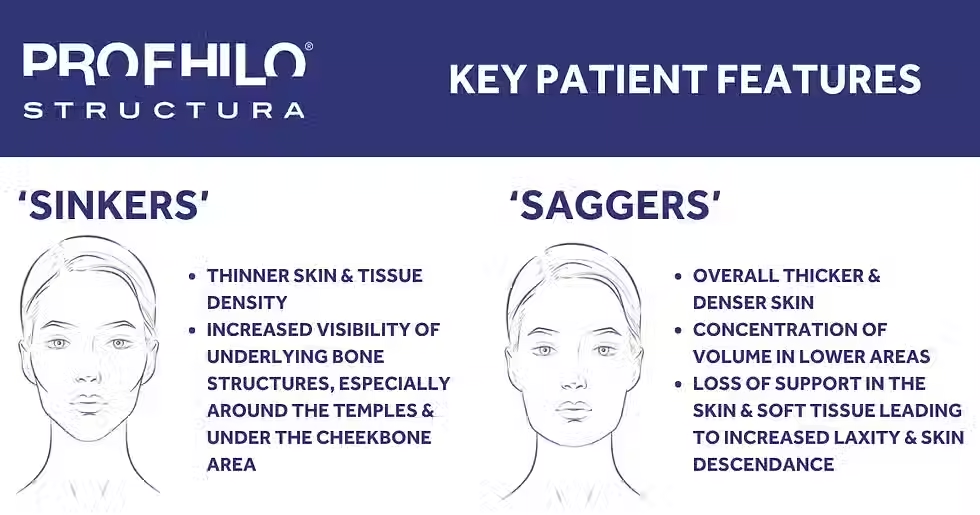
IBSA Derma identifies two ideal patient profiles:
Sinkers:
Patients with a hollow or sunken cheek appearance caused by depletion of lateral malar adipose tissue. This produces a gaunt or tired look despite healthy skin surface quality.
Saggers:
Patients where the soft tissue appears to slide from the bony contour, creating drooping, folds or bulges. The structural support within the fat and connective tissue has weakened, leading to a downward shift.
In simple terms:
Sinkers lose volume.
Saggers lose structure.
Structura targets both by working within the fat layer rather than sitting above it.
Safety and research
Profhilo has been studied in in vitro models, clinical trials, and post-marketing safety reporting across more than 4.3 million treatments, with availability in 80 countries . The safety profile is strong when injected by appropriately trained medical practitioners using correct anatomical technique.
Structura is built on the same NAHYCO platform, but its indications differ, and it should only be used by clinicians trained specifically in this formulation.
Which one should you choose?
A simple way to think about it:
If your main concern is:
• dullness
• dehydration
• crepey texture
• early laxity
• fine lines
Choose Profhilo.
If your main concern is:
• deflation
• hollowing
• sagging
• visible fat compartment shift
• menopause-related facial thinning
You may benefit from Structura, or a combination protocol.
For many patients 40+, the most natural and impressive result combines structural support + skin remodelling, without changing facial identity.

Injection technique for Profhilo
Profhilo is placed in the dermis using the Bio Aesthetic Points (BAP) method. The technique is designed to allow even diffusion of the product across the mid and lower face, using only five injection points per side. Rather than creating volume at a single site, Profhilo spreads through the dermal matrix, hydrating and remodelling tissue over time.
The product is delivered using a needle, usually a 29G, with small bolus deposits placed directly into the deep dermal layer. Each point receives an identical volume so that the concentration gradient drives distribution across the natural tissue planes.
The five BAP points (per side)
IBSA identifies the following anatomical landmarks as the most efficient injection points for diffusion:
Zygomatic projection
Along the lateral cheekbone to support the mid-face skin envelope.
Nasal base
Near the alar region, improving hydration where skin is often thin and movement is frequent.
Tragus area
Placed anterior to the tragus to influence lateral cheek support and skin tone.
Chin
At the mentum, where laxity and fine lines are common with ageing.
Mandibular angle
Along the jawline to improve definition and soften skin laxity in the lower face.
Each point is injected with 0.2 ml, giving a total of 2 ml per session.
Needle placement and volume
• Needle: typically 29G
• Depth: deep dermis
• Volume: 0.2 ml at each BAP point
• Total dose: 2 ml per treatment
Boluses should be slow and controlled to prevent superficial pooling. Once placed, the hyaluronic acid diffuses through the ECM, binding water and stimulating fibroblasts, which drives gradual improvement in skin quality.
Clinical interpretation
Where Structura behaves like a woven mesh in the fat layer, Profhilo behaves like a “hydrating web” in the dermis. The BAP points are chosen because they sit along natural vectors of diffusion. The product travels through the reticular dermis in the same way ink will diffuse evenly across wet paper from a few central drops rather than dozens of scattered dots.
The five-point pattern reduces the number of injection sites while ensuring homogenous spread. It avoids unnecessary trauma and helps deliver consistent results across different face shapes.
How is Profhilo Structura injected?
Structura is delivered using a cannula rather than a needle, which is the key procedural difference compared with classic Profhilo. Practical familiarity with cannula work is recommended before adding Structura to clinical practice, as the product is positioned in the superficial fat layer rather than the dermis.
Technique for facial hollowing (Sinkers)
Patients with “sinking” typically present with thinner soft tissue, reduced fat volume and greater visibility of bony contours, particularly at the temples and beneath the zygomatic ridge.
Technique guidance (IBSA Derma):
• Plane: superficial fat compartment of the preauricular region
• Method: retrograde fanning using a 22G × 50 mm cannula
• Dose: 1 ml per side
• Entry point: 2 cm anterior to the tragus
This places the product within the lateral support system, where early adipose depletion tends to be most visible.
Technique for facial sagging (Saggers)
Patients with “sagging” often display thicker and denser skin with volume concentrated lower in the face. Support has been lost higher up, allowing the fat pads to descend, contributing to laxity and folds.
Technique guidance (IBSA Derma):
• Plane: superficial fat compartment over the preauricular area and along the zygomatic arch
• Method: retrograde injection using a 25G × 38 mm cannula
• Dose: 0.5 ml per side into the preauricular region and 0.5 ml per side along the zygomatic arch
• Entry point: 3 cm anterior to the tragus
This restores support closer to the bony scaffold, helping resist downward migration of the fat pads.
Clinical interpretation
Think of the placement as restoring anchor points. For “Sinkers”, the aim is to replace lost volume in the lateral fat pad. For “Saggers”, the priority is to reinforce the upper support zone, where the descent begins. The cannula allows a smooth, retrograde thread through the fat layer, encouraging integration rather than deposit.

Pricing and booking
Our pricing is always transparent, and full treatment fees for Profhilo and Profhilo Structura are listed on our Treatments page. If you are unsure which treatment is most suitable, we offer medical consultation to design a personalised plan based on your skin history and aesthetic goals.


Comments